Deduction vs Induction: Why Spinoza Distrusted Induction

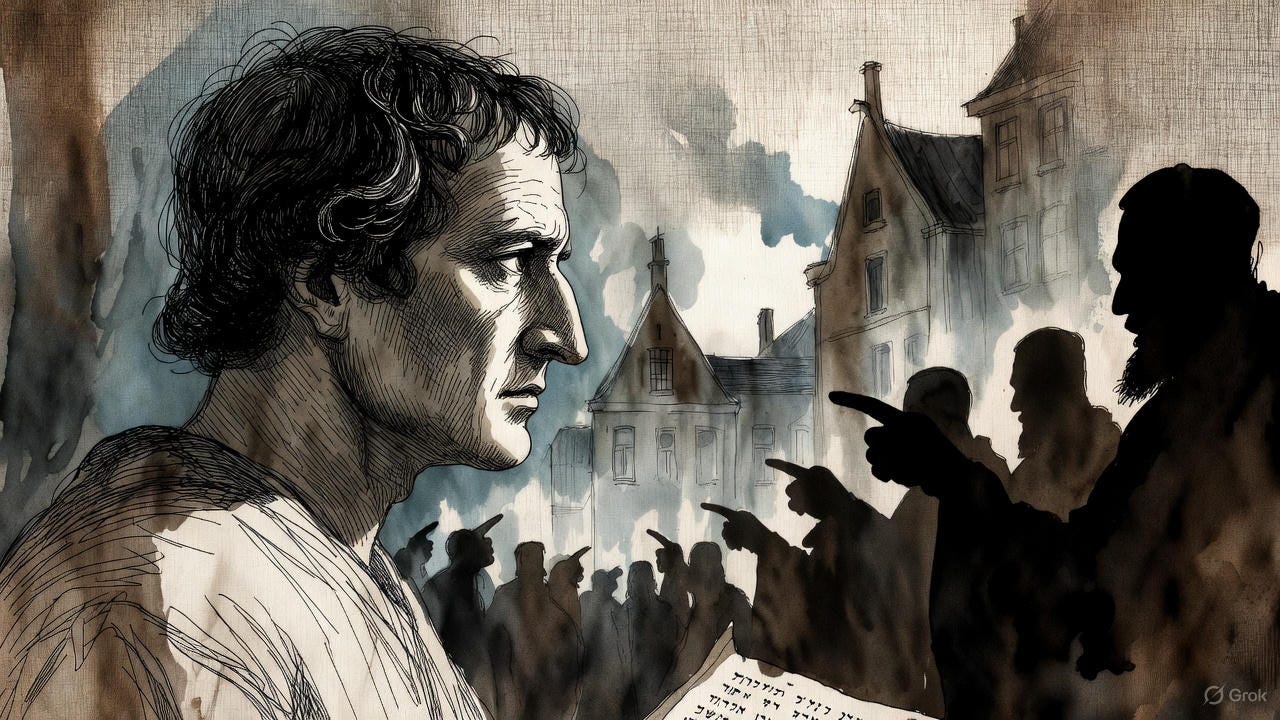
In the 17th century, a young man was expelled from the Jewish community.
His crime: “blaspheming God.”
He lived his entire life in poverty and eventually died of tuberculosis at the age of 44.
Yet thinkers like Nietzsche and Einstein—geniuses of their age—named him the philosopher who changed my life.
This man is the rationalist of the attic, Baruch Spinoza.
Here he is, quietly grinding lenses.
Excommunicated from his community, owning nothing but a single set of clothes.
No wealth, no security, no future.
And yet, his expression remains calm—almost serene.
Spinoza believed in only one thing:
a single order that explains everything in the world, the very first cause.
He called this fundamental substance God.
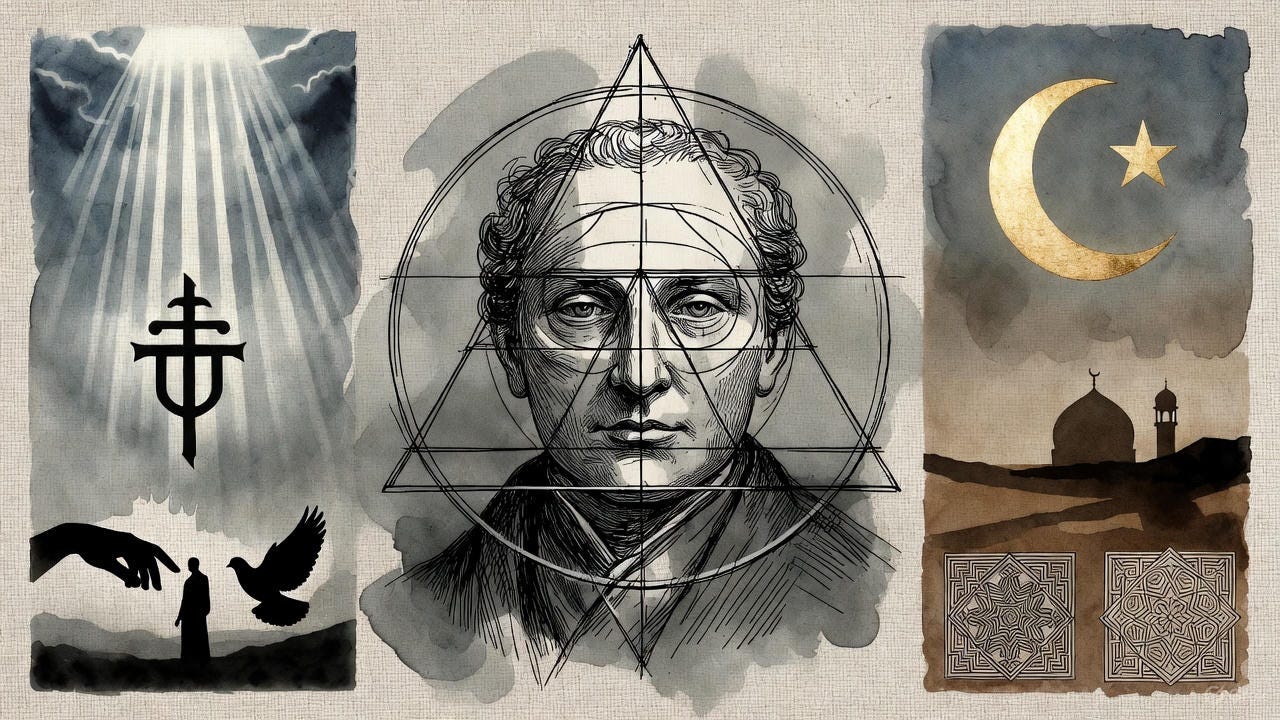
But the God he spoke of may have nothing to do with
“a creator who one day decided to make human beings.”
It was precisely this view that made his community despise him.
Spinoza begins by analyzing what change is.
He divides change into three parts:
the object that undergoes change,
the action that produces the change,
and the result produced by that action.
He calls the action of change affectio,
and the result of that action modus.
Here, an important concept appears.
Substance (Substantia) is that which exists by itself and needs nothing else to be explained.
By contrast, Mode (Modus) is a transformed appearance of substance—something that always depends on something else to exist.
Laughter requires a face.
Therefore, laughter is a mode.
Then is the face substance?
No. A face requires a body.
So the face is also a mode.
Then is the body substance?
Again, no. The body depends on countless other conditions.
If you keep tracing this chain of dependence upward,
you eventually reach the “first thing” that depends on nothing else.
Spinoza called this first substance God.
The very fact that something exists—that it “is”—is the first cause.
Spinoza believed that every entity in the world
exists necessarily through causal relations.
And he wanted philosophy to become
a geometric structure—something that does not waver.
In geometry, axioms do not change,
are not influenced by hidden intentions,
and always lead to the same conclusions.
In other words: deduction.
Deduction and induction are usually explained like this:
“Deduction moves from general facts to specific conclusions.”
“Induction moves from specific facts to general conclusions.”
But these are simplified explanations meant only to help understanding—and they are incorrect.
Here is a counterexample that shows why:
Premise 1. Smart people tend to be good at mathematics.
Premise 2. Yana is smart.
Conclusion. Therefore, Yana will be good at mathematics.
According to the traditional definition, this should be deduction because it moves from a “general fact” (Premise 1)
to a “specific fact” about Yana.
However, because the premises do not guarantee the conclusion, this is actually an inductive argument.
In other words, the difference between deduction and induction lies in necessity versus probability.
What Spinoza wanted was necessity—
a structure into which emotion, politics, and contingency cannot intrude.
Induction does not guarantee necessity.
Its validity always depends on a kind of rhetorical persuasion.
It is incomplete, provisional, and always revisable.
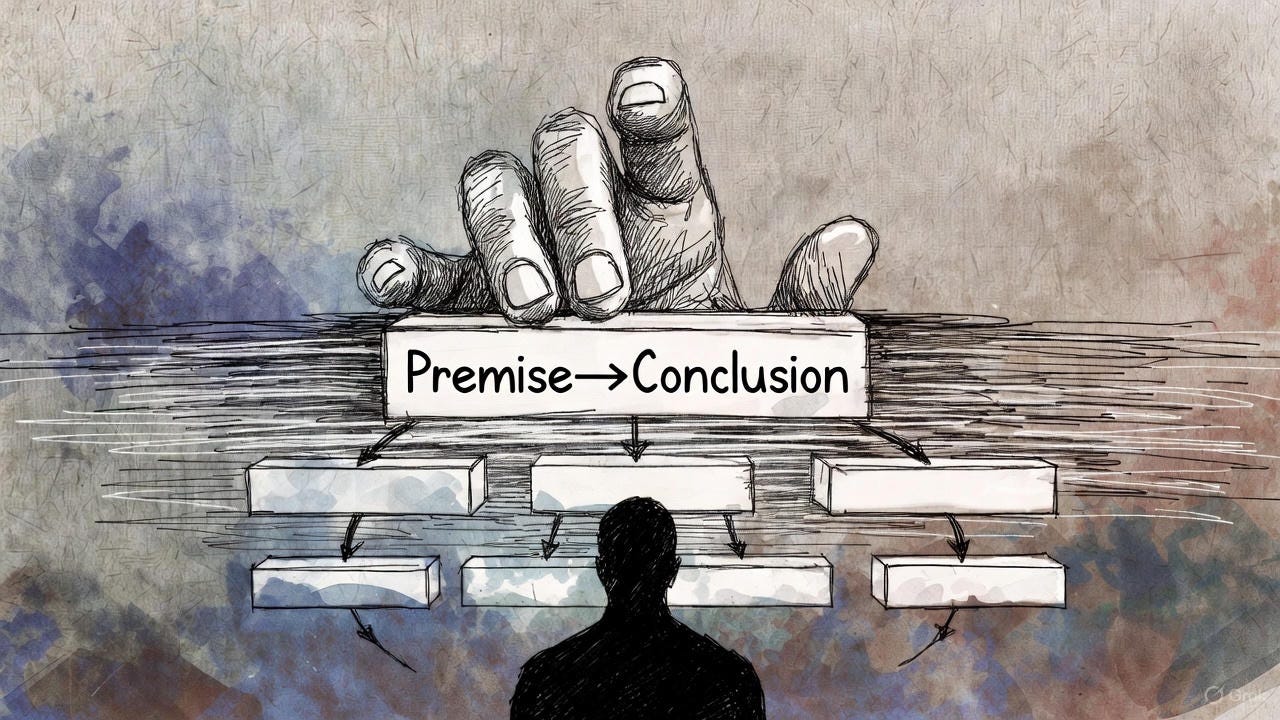
Yet in human society,
induction often disguises itself as deduction.
The connection between premise and conclusion depends on human belief,
and sufficiently strong authority can “freeze” that connection as if it were self-evident.
If we were to match deduction and induction with a single word,
deduction would be closure,
and induction would be openness.
Deduction follows already-determined truths
and checks logical validity.
A person making a deductive argument is simply
showing a truth that is already settled—
a truth that others fail to see only because their cognitive processing is too slow.
It can feel like discovery,
but in fact, deductive reasoning merely reveals what was already there.
Induction, on the other hand, is always incomplete
and embraces new possibilities.
Albert Einstein’s greatest confidence in himself
came from his “intuition.”
A new way of thinking, a new paradigm—
the creativity to dismantle Newton’s enormous and beautiful system
and construct a more coherent deductive structure.
This was the source of Einstein’s self-assurance.
And it did not come from the closed structure of deduction.
Richard Feynman, meanwhile, practically failed the literature section
of his college entrance exams—the part with no clear right answers.
He reacted emotionally and negatively to that experience.
But as he grew older, he said the most important thing for human beings is love.
And love is not something that can be explained deductively.
It comes from embracing uncertainty and unpredictability.
As humanity moves through history,
we gradually come to value this attitude of openness more and more.
Your explanation of how induction disguises itself as deduction was so clear.
It’s fascinating (and a little frightening) how a collective belief can “freeze” a probability and present it as necessity.
In the end, we don’t follow logic — we follow the stories we choose to trust.