Charity: Right vs Wrong

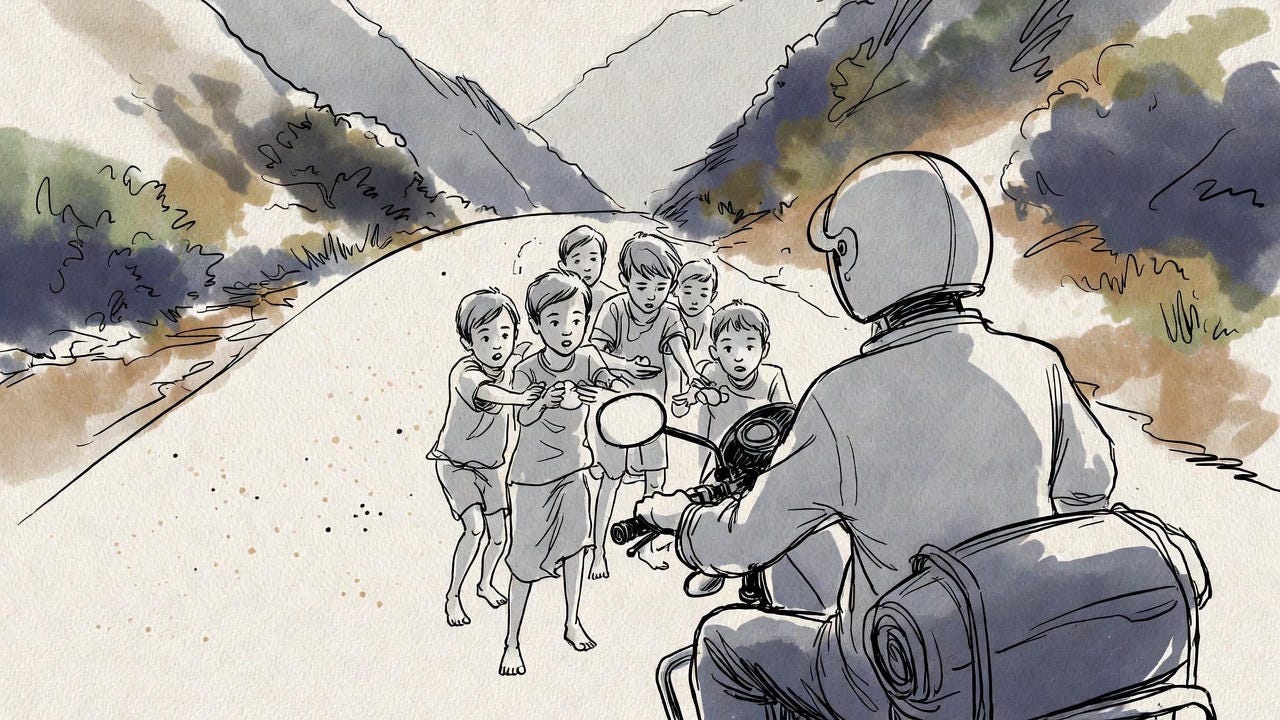
On a mountain road in northern India, a traveler riding a motorcycle is stopped by a group of children.
“Please give us some food!”
The traveler takes biscuits out of his bag and places one into each child’s hand.
The children smile, and the traveler records the scene and uploads it to social media.
The comments quickly split into two camps:
“A beautiful act of kindness for hungry children!”
“Such behavior reinforces a begging culture and endangers the next traveler.”
The traveler clarifies, “I didn’t give money, only food,” but the debate does not stop.
The internet of the 21st century is a mirror that sharply reveals how temporary and fragile the values we believe to be firm truly are.
This is not because humans are unintelligent or because we deceive ourselves.
The issue itself is so multidimensional and complex that a single deductive answer is impossible.
This incident can be divided into intention and outcome.
The intention to feed a hungry child is good.
The immediate outcome—relieving a child’s hunger—is also good.
But if we expand the scope of the outcome even slightly, the evaluation changes.
If such behavior is repeated, children may choose the streets over school, travelers may be stopped more frequently, and in some regions begging may develop into an organized cycle.
The key question becomes:
How far do we extend the range of consequences?
A narrow range makes the act appear virtuous.
A broad range makes it appear harmful.
In other words, whether the outcome is good or bad is not an objective truth—
it depends on who draws the temporal and moral boundaries.
The opposing view often appears more sophisticated because it appeals to a wider frame:
“The safety of future travelers and the long-term well-being of the local community.”
But they, too, are not free from the criticism that they chose those boundaries arbitrarily.
What if that single biscuit planted a small hope in one child, who then returned to school and slowly changed the community?
Such a parallel world is entirely possible.
Ultimately, judgments about intention and outcome are not absolute standards but frames each person chooses to persuade themselves.
Once that frame is declared universally “right,” morality turns into power.
Philosophers who relied on universality wanted to resolve this discomfort.
When intention and outcome can be interpreted differently by each person,
and when the rightness of an action collapses into a battle of frames,
thinkers found the situation deeply troubling.
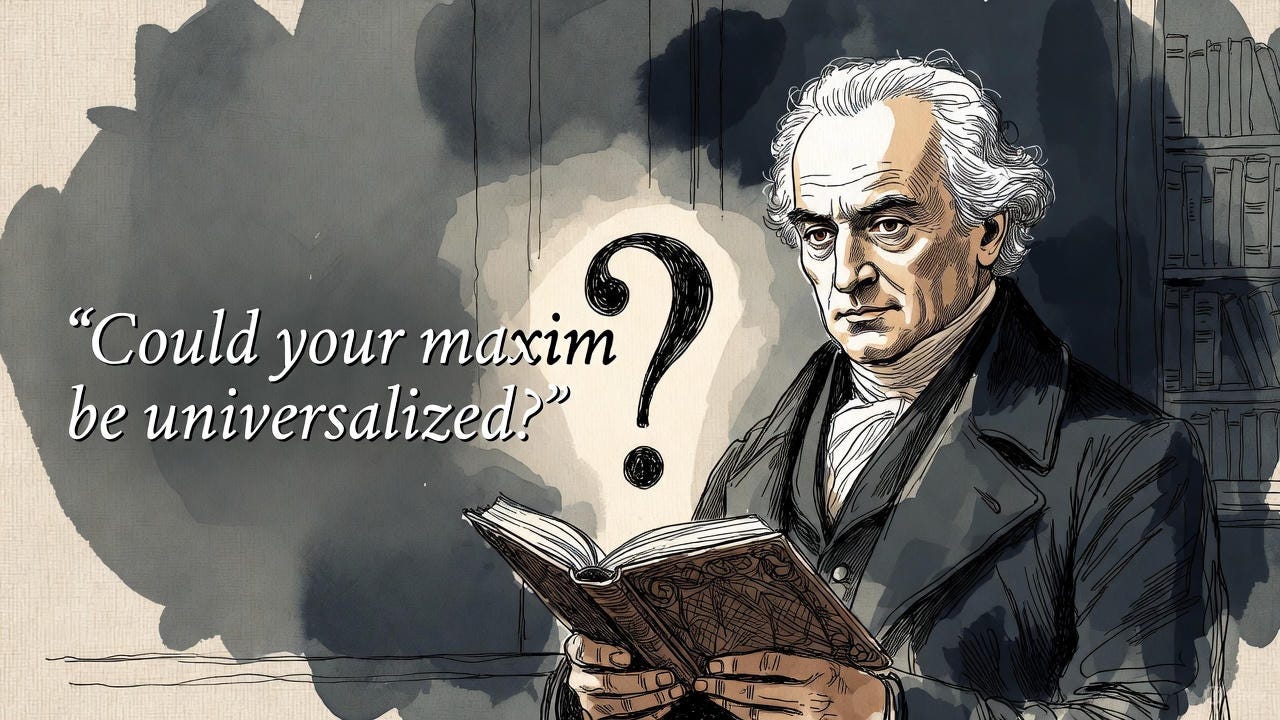
One such thinker attempted to remove arbitrariness entirely by asking:
“Could the maxim of your action be followed by everyone simultaneously?”
Judged by his standard, this incident becomes very interesting.
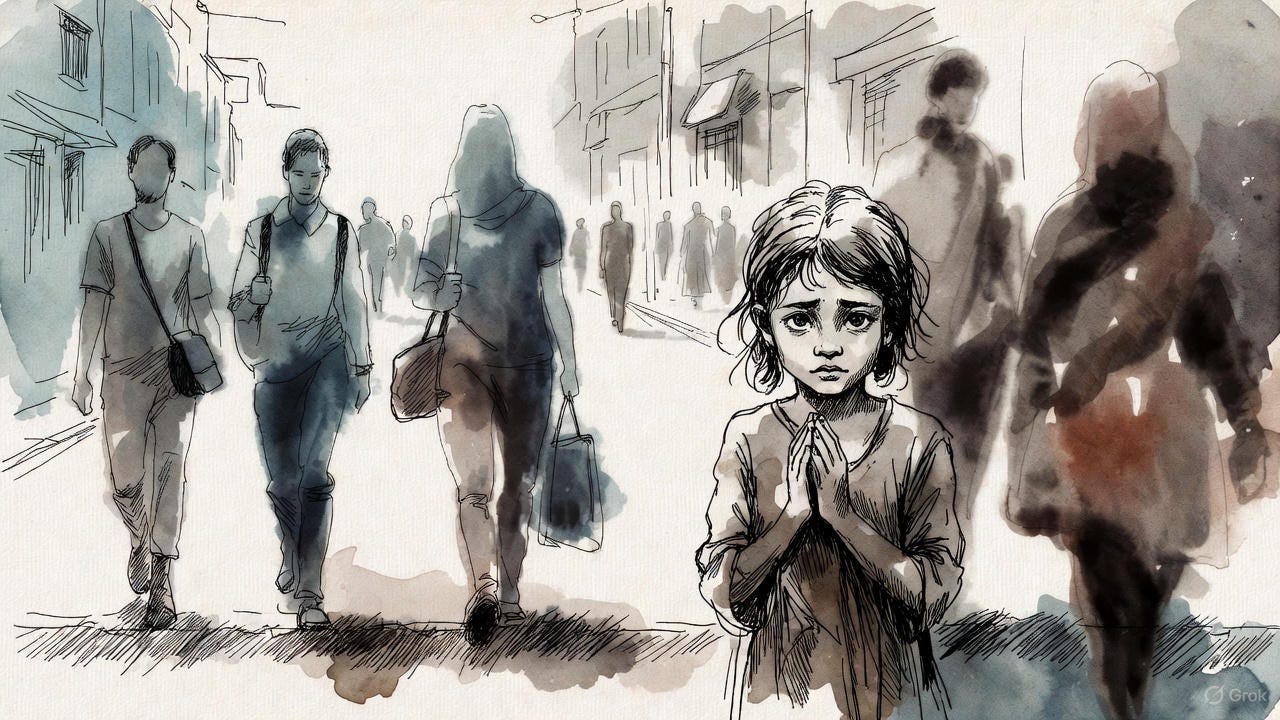
If the maxim “Give food to a hungry child” were followed by everyone at once,
children across India would flood the streets and travelers would no longer be safe.
This maxim cannot be universalized.
Conversely, if everyone followed the maxim “Ignore children who beg,”
the dignity of those children would be disregarded, and their hunger ignored.
This maxim cannot be universalized either.
In the end, neither position passes the test.
Universality itself is a kind of unreality.
The rule “Your action is permissible if it can be universalized” sounds correct only because universality is an imagined ideal.
Humans cannot possibly imagine all contexts involved in every action.
It is like imagining a horse with a single horn:
once it exists only in imagination, you are free to imagine it however you wish—
because it does not exist in the first place.
This “biscuit debate” is a debate without an endpoint.
Each time we encounter such a video, we are forced to ask ourselves:
Is the ‘right’ I believe in truly a principle that could apply to everyone at the same time?
Is the range of consequences I’m considering wide enough, or too narrow?
Is the frame I insist on truly moral, or is it an exercise of power?
The internet drags us into endless self-interrogation.
It is uncomfortable and exhausting,
but it may be the only way we become even slightly better human beings.
And eventually, we must make a decision and face its consequences—
an act that is, perhaps, deeply human.